
Institute Electrochemical Energy Storage
Coin Cell Format
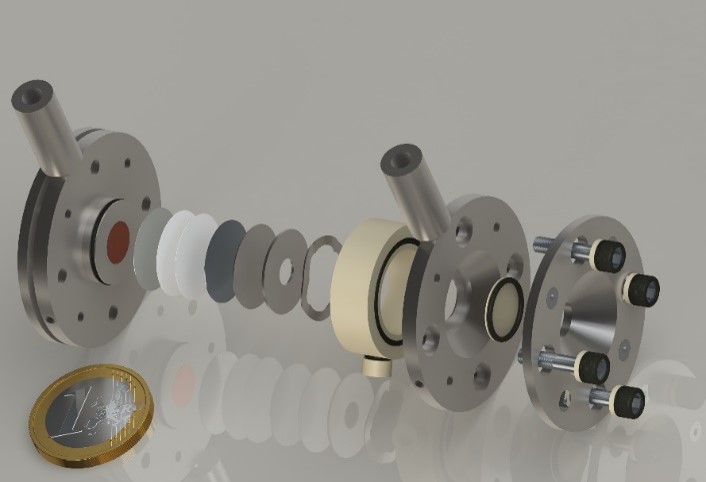
Flexible Operando Battery Cell Based on CR2032 Geometry
A flexible operando battery cell has been developed based on the geometry of the widely used CR2032 coin cell, combining standardized dimensions with unprecedented adaptability for advanced characterization techniques. This innovative cell design integrates an interchangeable window system, allowing for the integration of various radiation probes without compromising electrochemical performance. Researchers can easily switch between window materials optimized for soft, tender, or hard X-rays, neutron beams, or laser radiation for spectroscopic techniques such as Raman.
This versatility enables the use of a broad suite of operando and in situ methods. The cell supports X-ray spectroscopy (e.g., XAS, XPS), X-ray diffraction (XRD), small- and wide-angle X-ray scattering (SAXS/WAXS), and full-field or scanning X-ray imaging. Its compatibility with neutron scattering further expands the analytical capabilities to bulk-sensitive techniques, while optical access allows for laser-based methods and fiber-coupled UV-vis spectroscopy during electrochemical operation.
One of the defining features of this design is the lateral (side) access, which allows additional probes to be introduced into the cell. This includes temperature sensors, reference electrodes for three-electrode configurations, or additional optical fibers for in situ/operando UV-vis analysis. This opens the possibility to study dynamic changes in battery components under controlled temperature conditions or to isolate specific electrode reactions in real-time.
The cell design has been carefully optimized and iterated as part of the OpMetBat (Operando Metrology for Battery Systems) project, with a particular focus on improving metrological robustness, signal stability, and reproducibility across different beamlines and laboratory setups. These developments have led to a standardized, high-performance platform that can be reliably used in both synchrotron and laboratory environments.
Today, this CR2032-based operando cell is in wide circulation among research partners throughout Germany and Europe. It has become the working horse of our group and serves as a common platform for joint studies, method development, and multi-modal analysis. Multiple units are available and can be shared with interested cooperation partners, facilitating collaborative research into battery materials, interfaces, and degradation mechanisms under realistic working conditions.
This standardized and modular cell design plays a key role in bridging fundamental materials science and applied battery research, ensuring reproducibility and comparability across different experiments and institutions.
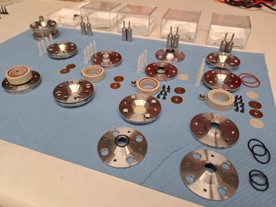
Cell Variants
Standard Version

This coin cell version represents our standard design. The entrance and exit area has an opening angle of 90°. The PEEK ring in the middle can have a hight of 6.5 mm, 7 mm, or 8 mm to host electrochemical sandviches of 0.5 mm, 1.0 mm and 1.5 mm, respectively. The upper steel part can be exchanged with a PEEK version to reduce fluorescence signal of iron if X-ray spectroscopy is used.
Flat and wide Version
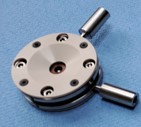
This cell design was developed to allow for a much wider opening angle of 120° for diffraction and angle-resolved X-ray spectroscopy. The internal design allows to host an electrochemical sandvich of 0.5 mm and enables a low dead volume of the cell, which is mandatory for systems under lean electrolyte conditions.