Irradiation & Characterisation
Gamma Irradiation
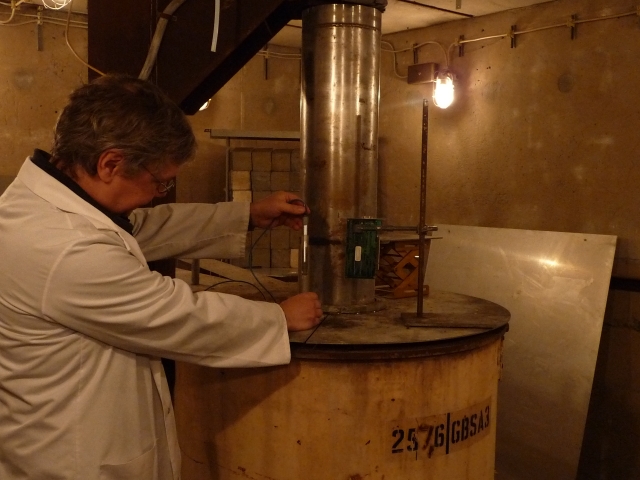
Cobalt source. Electronic device to be tested and dose rate meter are mounted in front of the cobalt source.
Kobalt-60 Source
For irradiation with gamma rays, for example for material testing or for applications in the medical or food industry, the HZB offers a cobalt-60 source. Cobalt-60 is a radioactive isotope (60Co). It arises when irradiating naturally occurring cobalt-59 with neutrons. The cobalt-60 thus produced decomposes into nickel-60, at the same time emitting beta and gamma rays. In our construction, a stainless steel jacket absorbs the beta radiation. The gamma rays with an energy of 1.17 MeV and 1.33 MeV with a max. Dose rate of 200 Gy / h are used for irradiation. Core conversions can not be caused with it.
The cobalt source is designed so that both small objects and larger objects can be irradiated. This results in a broad field for possible applications:
- Sterilization of objects (eg in the food industry)
- Protection of works of art and museum pieces against mold
- Testing electronic components to determine their lifetime in radiation fields such as space
Due to its intensity and construction, the radiation source is unique in Germany.
Magnetization, Conductivity, Polarization
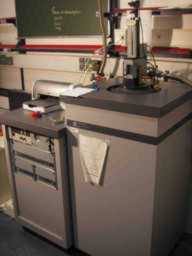
MPMS-T5 SQUID magnetometer for the temperature range between 2 K and 400 K. © HZB
SQUID Magnetometer
With our SQUID magnetometer we can perform magnetization measurements in the temperature range between 2 K and 800 K. Due to the slow movement of the sample during a measuring cycle, powder samples can also be easily measured. Even the small residual field of its superconducting NbTi magnet allows very reliable low field measurements.
In our Bulk Properties Lab we operate a variety of instruments for characterizing material properties. So we can measure in magnetic fields up to 14.5 T and temperatures up to 260 mK. The available measurement options are resistance, heat capacity, heat conduction, magnetocaloric effect and magnetization with PPMS or SQUID systems. Other measurement options such as dielectric constant measurement, electrical polarization measurement or cantilever magnetometer are available upon request.
Supralab
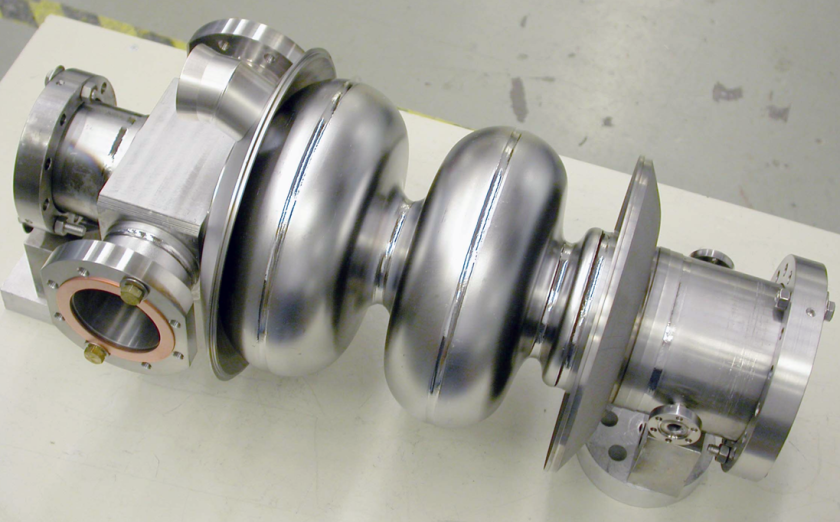
Cavity
Test infrastructure for accelerator devices, superconducting radio-frequency systems and cryogenic applications
Particle accelerators address a very wide range of applications from particle physics to materials research as well as industrial and medical applications. Increasingly, superconducting radio-frequency systems (SRF) are the enabling technology for both large-scale and compact systems.
The SupraLab at HZB provides, at one location, the infrastructure suite and testing expertise for the entire SRF development chain from first superconducting sample analyses all the way through full SRF module operation.
Overview: State-of-the-art test facilities at SupraLab
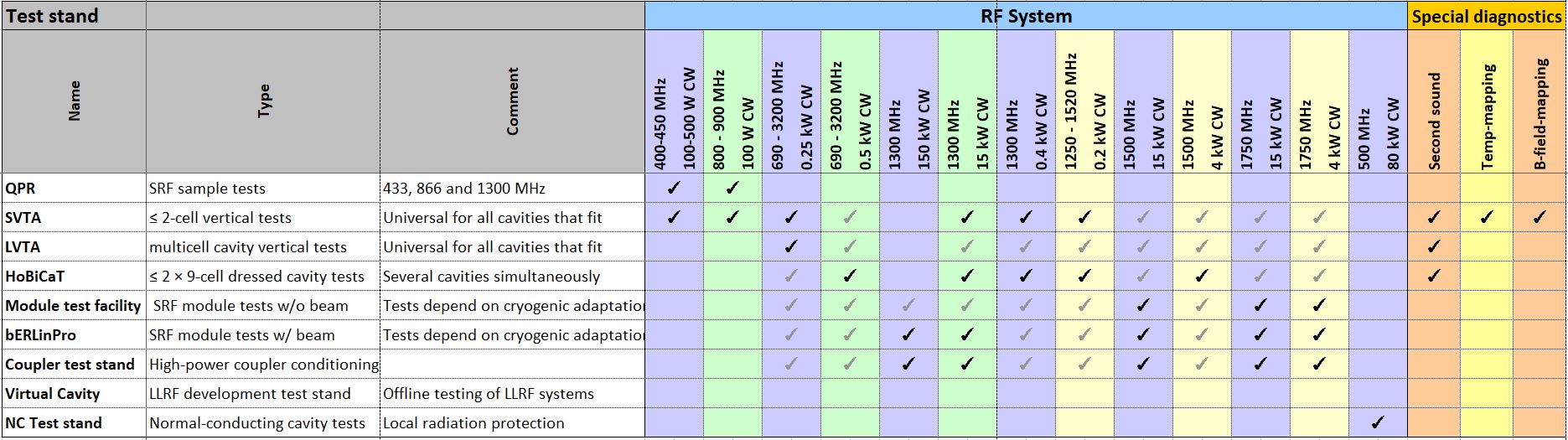
Summary of test stands, RF sources and diagnostics offered by HZB. Black check marks indicate that the RF source is available at the stand. Gray check marks point out which sources in principle can be operated at a given test stand. For more details please click PDF-File „Overview SupraLab“.