
© HZB / Michael Setzpfandt
Program Open Day
Please bring the original of a valid identity document (aged 16 and over) with you when you arrive.
Stations
Promotion of Early Career Researchers Learn more about our offers for researchers and postdocs. If you are interested in joining the center or are looking for career advice, come and talk to us. Supervisors are also warmly invited to stop.
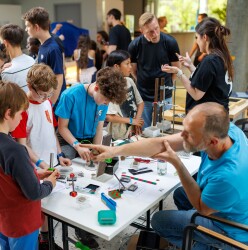
Metadata – The Key to Precision Why is metadata important for science? Build a LEGO figure using only a vague description – and see how difficult could be. Then try again with detailed instructions and see the difference.
Cooking with solar power If there will be enough sunshine we want to cook potatoes with the solar cooker. If it is cloudy, we explain how it works.
BESSY III: The materials discovery machine of the future! BESSY III, one of Europe's most advanced X-ray sources, is being built in Berlin-Adlershof. From the middle of the next decade, it will enable completely new insights into materials. Travel with us into the future!
Helmholtz Cloud – Connecting Germany’s Largest Research Centres Discover the Helmholtz Cloud – the digital platform that connects the 18 Helmholtz Centres at different locations.
Demonstration: Science with solar energy – from the lab to the garden How does a solar-powered electrochemical cell work? Experience, step by step, how photoelectrochemical cells are assembled and then tested outdoors.
On the road for radiation protection Take a look inside our measurement vehicle and find out how it is used in radiation protection and emergency preparedness. Discover how radioactivity and potential contamination can be reliably measured.
Together for Diversity at HZB
Did you know that almost half of our researchers come from abroad? People from a wide range of backgrounds work at HZB, bringing new perspectives and enriching our community. Find out how we are working to make HZB an open and vibrant place for everyone. (2 pm and 4 pm)
Green Deal Ukraїna Discover how the Green Deal Ukraїna project supports Ukraine's energy transition through research and energy system modelling. Test your knowledge about electricity and the energy system of the future.
Protons for eye tumours therapy How can particles from the accelerator in Wannsee, in collaboration with Charité – Universitätsmedizin Berlin, help to treat eye tumours? In addition, we also use protons to simulate cosmic radiation and test electronic components for space travel.
Tomography Lab How can we look inside materials without cutting them open? We show some examples – from batteries and catalysts to fossils and ancient papyrus.
© HZB / Kevin Fuchs
© HZB / Dirk Laubner
Guided tours
Tickets for the guided tours will be available from the information desk from 2 pm!
A glimpse into the world of microscopy (15:40, duration 30 mins, 8 people, pregnant women not permitted) What do hairs look like under an electron microscope? What do solar cells have to do with layer cakes? We show how we make the tiniest details visible.
CO2 capture and conversion lab tour (15:30 & 16:30, Dauer 20 min., 12 Personen, Englisch) In our labs we use electricity to capture CO2 from air and convert it into valuable chemicals. See how we make catalyst-coated electrodes, test them, and analyse the different gas and liquid products which are formed.
Growing the materials of the future: Quantum materials on Semiconductor Platforms (15:20 & 16 Uhr, Duration 20 min., 10 Participants) Take a behind-the-scenes look at our Molecular Beam Epitaxy (MBE) laboratory, where we grow crystalline thin films almost atom by atom.
From research to battery cells (15:00, duration 30 mins, 8 people, in English and German) Discover the HZB pouch cell laboratory, where we are producing and testing novel pocket-sized lithium-sulphur batteries.
Atomic layer deposition laboratory (14:10, 14:45, 15:20, 15:55, 16:30, Dauer 30 min) In this lab, we demonstrate atomic layer deposition and etching at the nanometre scale for advanced electronics.
Guided Tours in German
Renaturierung der Streuobstwiese (14:45, 15:30, 16:15, 17:00, Dauer 30 min., 12 Personen) Wie viele Obstsorten stehen auf unserer Streuobstwiese? Warum lassen wir abgestorbene Baumstämme stehen? Die Führung gibt einen Einblick, wie wir in den letzten Jahren die Streuobstwiese renaturiert haben.
Hinter den Kulissen der Gebäudetechnik (14:15, 15:15, 16:15, 17:15, Dauer 45 min., 10 Personen) Entdeckt die technische Infrastruktur, die unsere Forschung täglich ermöglicht – von Strom, Wärme und Kälte bis hin zu Wasser, Luft und Gasen.
Einblicke in die Mikroskopiewelt (14:10, 14:55, 16:25, 17:10, Dauer 30 min., 8 Personen, keine Schwangeren zugelassen) Wie sehen Haare im Elektronenmikroskop aus? Was haben Solarzellen mit Schichtkuchen zu tun? Wir zeigen, wie man kleinste Details sichtbar machen kann.
Dünnschicht-Labor: Die Kunst der Dünnschichtherstellung (15:00, 15:45, 16:30, Dauer 20 min, keine Schwangeren zugelassen, Personen unter 16 J. nur mit volljähriger Begleitperson, 6 Personen) Ob für Solarzellen, Batterien oder für solare Brennstoffe: überall werden dünne Schichten benötigt. Wir zeigen, wie man sie gleichmäßig herstellen kann.
Forschen mit ultraschnellem Licht aus dem Laser (15:15, 16:00, 16:45, Dauer 20 min., 6 Personen) Mit extrem kurzen Laserpulsen untersuchen wir blitzschnelle Vorgänge in Materialien.
Geniales Sonnenlicht (15:30, 16:15, 17:15, Dauer 20 min., 6 Personen) Untersucht die Lichtspektren von Halogenlampen, Neonröhren, Sonnensimulatoren und LEDs – und vergleicht sie mit dem Sonnenlicht. Wir zeigen, wie man das Licht der Sonne nutzen kann, um Wasserstoff zu erzeugen.
Aufgaben der Landessammelstelle für radioaktive Abfälle (14:15, 15:15, 16:15, 17:15, Dauer 45 min., 12 Personen) In Industrie, Forschung und Medizin entstehen radioaktive Abfälle, die gesammelt und gelagert werden müssen. Das HZB hat diese verantwortungsvolle Aufgabe für das Land Berlin übernommen. Wir erläutern die Abläufe und zeigen anhand von Beispielen die typischen Abfälle einer Landessammelstelle für radioaktive Abfälle.
Der BER II im Nachbetrieb (14:15, 14:45, 15:15, 15:45, 16:15, 16:45, 17:15, Dauer 30 min., 8 Personen, Voraussetzung: Mindestalter 18 Jahre, gültiger Personalausweis (alternativ Reisepass) im Original) Bei der Führung erfahrt ihr, wie sich der Forschungsreaktor BER II seit seiner Stilllegung verändert hat, was heute im Nachbetrieb geschieht und welche Schritte noch notwendig sind, um den Reaktor für den Rückbau vorzubereiten. Außerdem haltet ihr Einblicke in den Transfer der wissenschaftlichen Experimentier-Einrichtungen.
Augentumortherapie mit Protonen (14:30, 15:00, 15:30, 16:00, 16:30, 17:00, Dauer 45 min., 15 Personen) Wie können Teilchen aus einem Beschleuniger dabei helfen, Augentumore zu behandeln? Bei dieser Führung erfahrt ihr, wie die in Deutschland einzigartige Protonentherapie am HZB funktioniert.
Kristallstrukturen auf der Spur (14:30, 15:30, 16:30, 17:30 Uhr, Dauer 30 min, keine Schwangeren zugelassen, Personen unter 16 J. nur mit volljähriger Begleitperson, 8 Personen) Kristalle faszinieren uns und haben nützliche Eigenschaften. Um sie zu verstehen, untersuchen wir ihren Aufbau mit Röntgenstrahlung. Wie das in der Praxis geht, möchten wir beim Rundgang durch das Röntgenlabor vorstellen.
Batterien erforschen (15:00, Dauer 30 min, 8 Personen, auf Englisch und Deutsch) Entdeckt das Pouch-Zellen-Labor, in dem wir neue Lithium-Schwefel-Batterien im Taschenformat herstellen und testen.
Talks
--> All presentations last 30 minutes (unless otherwise stated) and take place in the seminar room.
14:15 Uhr: When atoms swirl: tiny vortices that could power tomorrow's electronics What do ferroelectric vortices, hurricanes, and water currents have in common? In this talk, we explain the connection between these phenomena, and show how ferroelectric vortices can be used for energy-efficient computing. (duration 30 min., Alfredo Blázquez Martínez)
The following talks will all be held in German:
14:45 Uhr: CO₂ mit Elektrochemie nutzbar machen Der CO₂-Gehalt in der Atmosphäre steigt. Ein wichtiger Ansatz ist, das CO₂ aus der Luft einzufangen und für neue Chemikalien und Kraftstoffe zu nutzen. Wir zeigen, wie sich mit erneuerbaren Energien elektrochemische Reaktionen antreiben lassen (Tamino Bosse).
15:15 Uhr: Aus Sonne Strom generieren Wie wird Sonnenlicht in elektrische Energie umgewandelt? Der Vortrag gibt Einblicke in die Forschung zu neuen Materialien für Solarzellen. (Prof. Susan Schorr)
15:45 Uhr: Augentumortherapie mit Protonen Wie können Teilchen aus einem Beschleuniger dabei helfen, Augentumore zu behandeln und wie funktioniert das genau? (Prof. Andrea Denker)
16:15 Uhr: BESSY III: Die Material-Entdeckungsmaschine der Zukunft Mit BESSY III entsteht in Berlin eine der modernsten Röntgenquellen Europas. Im Vortrag zeigt die Projektleiterin, welche neuen Forschungsmöglichkeiten die Anlage eröffnen wird und warum sie für Energie-, Material- und Quantenforschung so wichtig ist. (Dauer 15 min., Prof. Renske van der Veen)
16:45 Uhr: Wie Sonnenlicht Abfall zu Wertstoffen verwandelt Wie können wir aus Abfallprodukten wertvolle Chemikalien umweltfreundlich herstellen? Der Vortrag zeigt, wie Sonnenlicht genutzt werden kann, um Glycerin in höherwertige Produkte und grünen Wasserstoff umzuwandeln. Wir erläutern Herstellungsmethoden und künftige Anwendungen der Technologie. (Prof. Roel van de Krol)
17:15 Uhr: Vom Sonnenstrahl zum Strom – Wie moderne Materialien die Solarenergie revolutionieren Wie wird aus Sonnenlicht Strom? Wie können neue Materialien Solarzellen noch leistungsfähiger machen und warum ist ihre Erforschung wichtig für das Gelingen der Energiewende? (Dr. Thomas Unold)
17:45 Uhr BESSY III: Die Material-Entdeckungsmaschine der Zukunft Mit BESSY III entsteht in Berlin eine der modernsten Röntgenquellen Europas. Im Vortrag zeigt die Projektleiterin, welche neuen Forschungsmöglichkeiten die Anlage eröffnen wird und warum sie für Energie-, Material- und Quantenforschung so wichtig ist. (Dauer 15 min., Prof. Renske van der Veen)
Kids program
Face painting & temporary tattoos Whether it’s a butterfly, a tiger or a superhero – pop round and let us transform you!
School science lab – Discover light and colours Why does a screen display so many colours? What is white light made of? And what colours are actually in sunlight? Experiment with light and colours and build your own spectroscope.